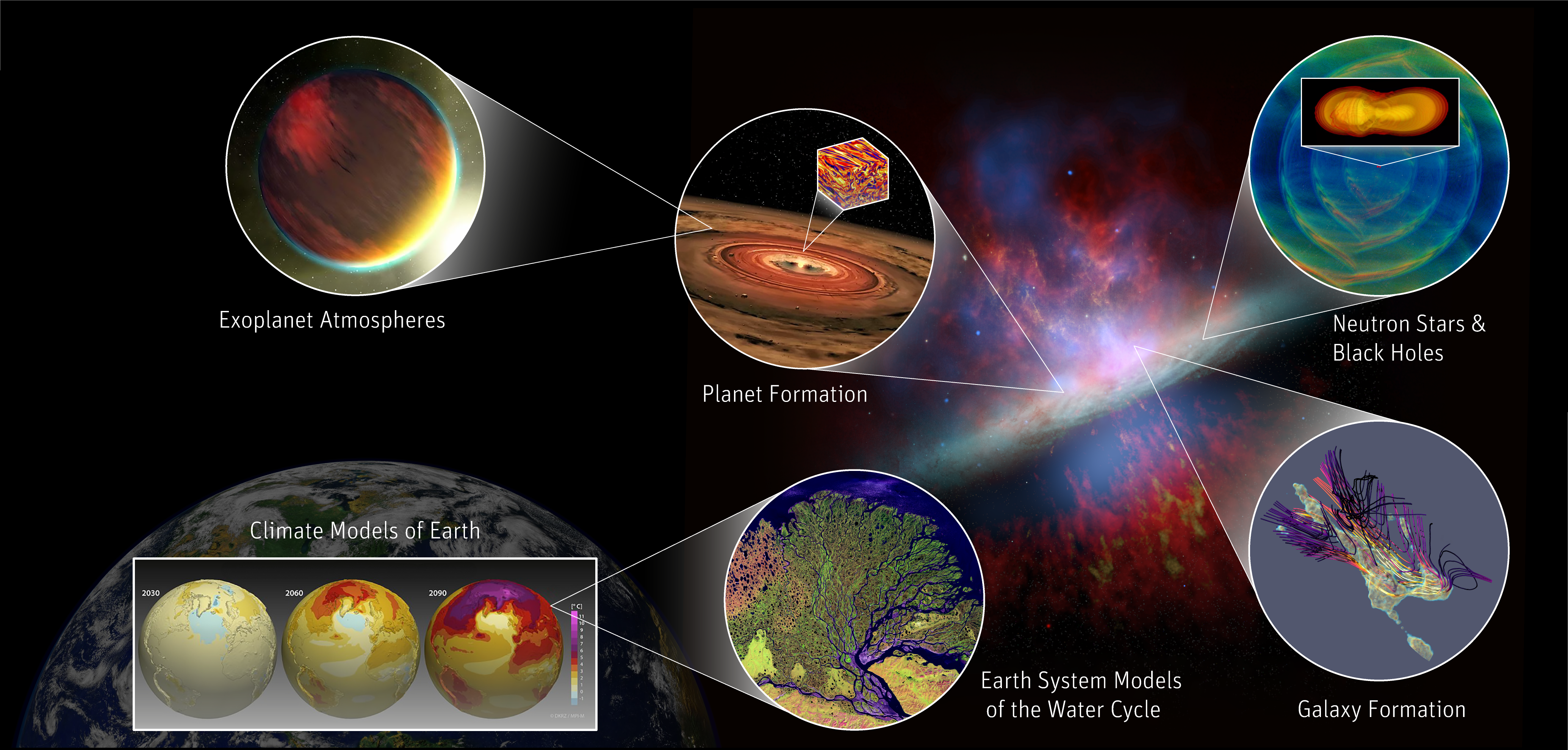
The Leibniz ScienceCampus SCALES ("Multiscale Problems: From Astrophysics to Climate Modeling") investigates complex physical systems in which processes span a wide range of scales - from cosmic dimensions down to tiny (sub)atomic scales.
New Approaches for Multi-Scale Physical Systems
Classical methods often fail to fully capture the interactions across these scales: feedback mechanisms are neglected, leading to inaccurate models and flawed predictions.
Our approach combines several strategies: large-scale simulations using novel computational methods, hybrid models in which local simulations complement larger systems, and physics-informed neural networks to describe local processes. A central element is the integration of data-driven methods that leverage observations and high-resolution simulations to continuously refine models and identify new phenomena. The applications considered range from astrophysics (e.g., galaxy formation, neutron star mergers, exoplanets) to Earth system science, including turbulence, climate, and the water cycle.
Achieving breakthroughs in the description of such multi-scale physical systems requires close collaboration across different scientific disciplines. At the same time, the project makes an important contribution to addressing global challenges and strengthens interdisciplinary collaboration in the Potsdam-Berlin region.
News
We are happy to announce the start of the Leibniz ScienceCampus on Oct 1, 2026. The first meeting of all ScienceCampus members and associates will take place on 25 November 2026 at the AIP.
The Senate of the Leibniz Association approved funding for a new Leibniz ScienceCampus, “Multiscale Challenges: from Astrophysics to Climate Models” on March 24, 2026. The Campus will be jointly funded by the participating Leibniz institutes, the Leibniz Association, the University of Potsdam, and the state of Brandenburg, with a total budget of 4.12 million euros.
The ScienceCampus SCALES contains 13 projects that are sorted into 5 scientific and 2 methodic focus areas.
Spokespersons
Prof. Dr. Christoph Pfrommer (AIP)
Prof. Dr. Tim Dietrich (UP)